
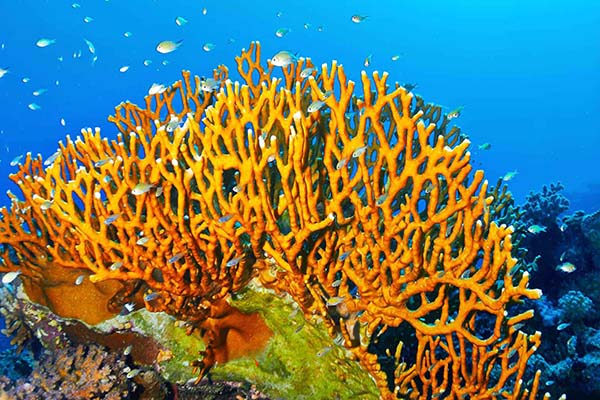

The Hidden Hazard: Ecology & Importance of Fire Coral (Millepora spp.) in Marsa Alam
The vibrant coral reefs of Marsa Alam are complex ecosystems, brimming with life and intricate interactions. Among the diverse inhabitants, the Fire Coral (Millepora spp.) often gets attention for its painful sting, sometimes overshadowing its unique biology and ecological contributions. While indeed a “hidden hazard” that divers must be aware of, Fire Coral is a fascinating organism that plays a distinct role in the Red Sea’s underwater tapestry. Understanding its ecology not only enhances your diving knowledge but also reinforces the interconnectedness of all reef life. Sambo Divers Marsa Alam is committed to fostering a comprehensive understanding of the marine environment, ensuring both diver safety and reef health.
Beyond the Sting: The Unique Biology of Fire Coral (Millepora spp.)
To truly appreciate Fire Coral, it’s essential to understand its biological classification and adaptations:
- A Hydrozoan, Not a True Coral: As mentioned, Millepora spp. are not true stony corals (Anthozoa) but belong to the class Hydrozoa, making them relatives of jellyfish, sea anemones, and other hydroids. This distinction is crucial to understanding their unique colonial structure and stinging cells.
- Colonial Organism with Specialized Polyps: Each Fire Coral colony is made up of numerous tiny, interconnected polyps, each specializing in a particular function:
- Dactylozooids: These are the defensive and capture polyps, equipped with potent stinging cells (nematocysts). They are longer and hair-like, giving the coral its “fuzzy” appearance.
- Gastrozooids: These are the feeding polyps, which ingest and digest the microscopic plankton captured by the dactylozooids.
- Gonozooids: These are reproductive polyps, responsible for releasing medusae (the free-swimming jellyfish-like stage) for sexual reproduction.
- Calcified Skeleton: Despite being a hydrozoan, Millepora secretes a hard, calcium carbonate skeleton, much like stony corals. This is why it looks and feels like a hard coral. This calcified skeleton contributes to the overall structural framework of the reef, often growing over existing dead coral or rock.
- Symbiotic Algae (Zooxanthellae): Like many true corals, Millepora spp. hosts symbiotic algae called zooxanthellae within its tissues. These algae perform photosynthesis, converting sunlight into energy, which the hydrocoral utilizes. This partnership explains Fire Coral’s preference for shallow, sunlit waters and its contribution to the reef’s primary production.
- Reproduction: Fire Coral reproduces both sexually and asexually. Sexually, they release tiny medusae that drift in the water column before settling and forming new colonies. Asexually, they can reproduce through budding (new polyps forming) and fragmentation (broken pieces reattaching and growing).
Ecological Role and Importance in Marsa Alam’s Reefs
While famous for its sting, Fire Coral plays several important ecological roles in the Red Sea:
- Reef Framework Contributor: By producing a calcified skeleton, Millepora spp. contributes to the structural integrity and growth of the reef, albeit often by encrusting or growing over existing substrates.
- Habitat Provider: The intricate structures formed by Fire Coral, particularly its branching or blade-like forms, can provide microhabitats for small invertebrates and fish that are immune to its sting or can navigate its thorny surface.
- Primary Production: Through its symbiotic relationship with zooxanthellae, Fire Coral contributes to the overall energy budget of the reef ecosystem, converting sunlight into biomass.
- Competition and Succession: Fire Coral can be a relatively fast-growing species, and in some cases, it can outcompete slower-growing stony corals for space, influencing reef composition and succession patterns. This can be a natural part of reef dynamics or, in disturbed areas, can signify a shift in the community.
- Food Source: While its stinging cells deter most predators, some specialized organisms, like certain nudibranchs or sea slugs, are known to feed on Fire Coral, sometimes even incorporating its nematocysts into their own defense mechanisms.
Threats and Conservation
Fire Coral is generally a robust and widespread species, not currently considered endangered. However, like all reef organisms, it is susceptible to broader threats to coral reef ecosystems:
- Climate Change: While often tolerant of some environmental fluctuations, extreme temperature spikes and prolonged marine heatwaves can lead to bleaching events, impacting even resilient species like Millepora.
- Ocean Acidification: The increasing acidity of ocean waters can make it more difficult for Millepora to produce and maintain its calcium carbonate skeleton.
- Physical Damage: Accidental contact from divers, boat anchors, or fishing gear can damage colonies, leading to breaks and stress.
- Pollution: Runoff from land-based sources can introduce pollutants that negatively affect its health and growth.
Sambo Divers Marsa Alam: Safe Exploration and Education
Understanding the Fire Coral (Millepora spp.) in Marsa Alam is about more than just avoiding a sting; it’s about appreciating a unique and vital component of the Red Sea’s complex marine environment. Sambo Divers Marsa Alam champions both diver safety and reef conservation:
- Comprehensive Briefings: Our dive guides provide thorough briefings on identifying potential hazards like Fire Coral and emphasizing safe interaction with all marine life.
- Buoyancy and Awareness: We stress the importance of mastering buoyancy control and maintaining constant situational awareness to prevent accidental contact with any part of the reef.
- “Look, Don’t Touch”: This universal principle is at the core of our diving philosophy, ensuring that all divers respect the delicate nature of the marine ecosystem.
By choosing Sambo Divers Marsa Alam, you embark on an adventure that balances thrilling encounters with a deep respect for the ocean’s intricate ecosystems. Learn to safely identify and appreciate the hidden importance of Fire Coral, contributing to the overall well-being of Marsa Alam’s magnificent Red Sea reefs.

0 Comment