
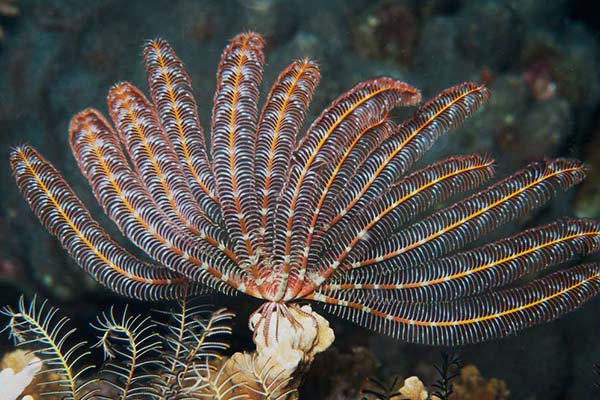

The Living Fossils: Ecology & Behavior of Feather Stars (Crinoids) in Marsa Alam
In the breathtaking underwater tapestry of Marsa Alam’s Red Sea, some creatures stand as direct links to primordial oceans, virtually unchanged over millions of years. Among these incredible “living fossils” are the Feather Stars (Crinoids). These graceful echinoderms, though often resembling vibrant marine plants, are active animals with a fascinating ecology and unique behaviors that contribute significantly to the health of the reef. Understanding the ancient lineage and the vital role of Crinoids in Marsa Alam provides a profound appreciation for the enduring power of evolution and the intricate balance of the marine ecosystem. Sambo Divers Marsa Alam is dedicated to unveiling these hidden wonders and fostering a deeper understanding of their importance.
An Ancient Lineage: The Enduring Ecology of Feather Stars (Crinoids)
Crinoids are among the oldest surviving groups of echinoderms, with a fossil record extending back over 500 million years. Their ecological success over such vast geological timescales is a testament to their highly efficient adaptations:
- Master Filter Feeders: The primary ecological role of Feather Stars is as efficient filter feeders. Their numerous feathery arms and pinnules are covered in a sticky mucus. As water currents pass through their extended arms, plankton, suspended organic particles, and detritus become trapped in this mucus. Tiny tube feet then meticulously move these food particles down grooves along the arms to the central mouth.
- Optimizing for Current: Feather Stars strategically position themselves in areas of the reef with good water flow. By extending their arms into the current, they maximize their feeding efficiency, essentially acting as living nets to sieve food from the water column. This process helps to clarify the water, benefiting other reef inhabitants.
- Nocturnal Dominance: While some species are always visible, many Feather Stars are primarily nocturnal. During the day, they often retract their arms and hide in dark crevices, under ledges, or deep within coral heads to avoid predation. At dusk, they emerge, climb to elevated positions, and unfurl their arms to feed throughout the night. This shift in activity is a critical adaptation that divers on night dives in Marsa Alam can readily observe.
- Mobility Beyond Perception: Despite their seemingly sessile appearance, Feather Stars are surprisingly mobile. They can slowly crawl across the seafloor using their cirri (claw-like appendages) and arms, allowing them to relocate if food sources dwindle or conditions change. Some species are even capable of a mesmerizing, undulating swimming motion by rhythmically beating their arms, often as a means of escape from predators like certain fish or sea urchins, though these swimming bouts are usually brief.
- Regeneration: Like many echinoderms, Feather Stars possess remarkable regenerative abilities. If an arm is damaged or lost due to predation or physical trauma, they can regrow it over time, a crucial survival mechanism.
- Commensal Relationships: Feather Stars often host tiny commensal organisms, such as specialized shrimp, crabs, or small fish, that live among their arms. These commensals benefit from the shelter and protection provided by the Feather Star without harming their host, adding another layer of biodiversity to the reef.
Reproduction and Threats
- Sexual Reproduction: Feather Stars typically reproduce sexually, releasing eggs and sperm directly into the water column (broadcast spawning). Fertilized eggs develop into free-swimming larval stages before settling onto the seabed and metamorphosing into the adult form.
- Threats: While generally considered robust due to their ancient lineage and adaptable feeding strategy, Crinoids are still vulnerable to large-scale habitat degradation. Coral bleaching events, ocean acidification, and physical damage to reefs can reduce the availability of suitable perching sites and impact their food sources. Pollution can also directly harm them.
Conservation and Ethical Observation with Sambo Divers Marsa Alam
The Feather Star (Crinoids) in Marsa Alam is more than just a beautiful creature; it’s a living testament to deep evolutionary time and a vital component of the Red Sea’s intricate food web. Sambo Divers Marsa Alam is committed to both showcasing these wonders and promoting their ongoing conservation:
- Respectful Observation: Always observe Feather Stars from a respectful distance. Their delicate arms and pinnules are easily damaged by touch or accidental fin kicks. Never attempt to pick them up or make them move.
- Buoyancy Control: For divers, maintaining impeccable neutral buoyancy is paramount. This prevents accidental contact with the Feather Star itself or the fragile coral structures on which they perch, preserving their habitat.
- Support Healthy Reefs: By choosing responsible dive operators and practicing environmentally conscious diving, you contribute to the overall health of the Marsa Alam reefs, which in turn supports healthy populations of Feather Stars and all other marine life.
To witness the silent grace and ancient lineage of a Feather Star (Crinoids) in Marsa Alam is to connect with the very essence of the ocean’s enduring beauty. Join Sambo Divers Marsa Alam for an enlightening dive adventure, where you can safely appreciate these unique “living fossils” and deepen your understanding of the Red Sea’s extraordinary biodiversity.

0 Comment